Volunteer, shares her Journey into Loss & Change, Death & Dying
Share this story
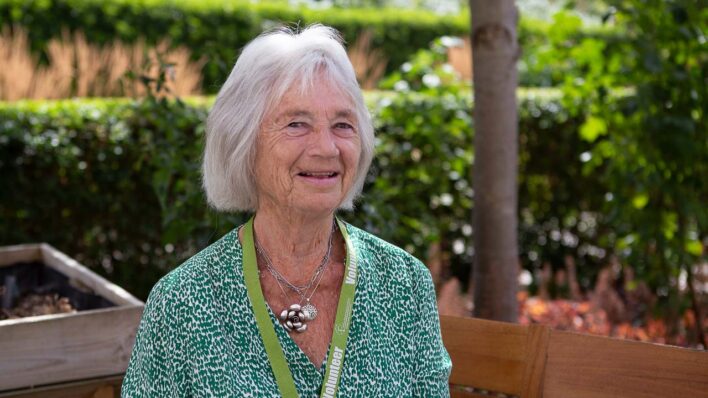
Elizabeth Stavely, aged 86, first volunteered for the Charity in 1981. She has seen many changes over that time and kindly shared her personal, professional and volunteering experiences:
“In the Autumn of 1981, I was recovering from a near death experience following an accident on my way to work. A chance essay in a large book by ‘Yalom’, whom I was studying in my training as a Psychotherapist, fell open on a page – which talked about the ‘Fear of Death’ being ubiquitous and at the bottom of most peoples’ psychopathology and which consumes us all in different ways. I thought then that death and life, therefore are interdependent.”
Death as a Taboo
“Death is a subject which is often evaded, ignored and denied by our youth worshiping, achievement-oriented society. Perhaps it has become another disease to be conquered. Perhaps too, death is a constant reminder, that in spite of all the technological advances of the present day, we are all still vulnerable and will experience this event.
“I believe recognition of death contributes to the richness and poignancy of life and indeed can shift the perspective of life. Learning about this awakened in me a need, at this time, to explore my own fear of death and started me on a journey which I am, years later still exploring.”
Here then begins my rich journey
“Psychiatrist, Elizabeth Kubler Ross, was teaching and writing about Grief, Loss and Death in the United States at the same time, though they did not know each other. They were pioneers bringing the subject of dying into the open. This was an important time for me and both these women were, and continue to be, inspiring to me and were moving me towards a journey that I am still exploring.”
Living in the moment
“I read extensively and began to realise that living each day for itself, in the knowledge of the inevitability of death, gave me a sense of peace and strength to deal with life’s disappointments and pain. I was learning to discover ways of increasing the experience of living in Mindfulness, each day and moment for itself and all the gifts it offered.”
Later, in 1981, I was attending a multidisciplinary team meeting where the speaker for the day was the newly appointed Matron, Raymond Tomkinson, who as well as being a senior Clinician, had been a Buddhist Monk. He talked very movingly about the newly opened Arthur Rank Hospice in Cambridge and I knew then that I was drawn to do work there. “
Arthur Rank Hospice
“I was lucky enough to get a placement under the wing of the Social Worker, Celia Lindsay. I had no role but for four months was able to do the regular shifts that the nurses did. Dr Tim Hunt and Dr Brotherton were the Doctors there at this time. It was my first experience of death and dying and I felt privileged to be allowed to accompany patients and staff in ways that had not previously been considered suitable for volunteers.
Raymond Tomkinson took me under his wing and, it was with his sensitive caring, that I was able to gather confidence to sit with dying patients, help to lay out those that had died and support the nurses to care for patients in whatever ways was helpful. I experienced so many rich encounters with patients who wanted me to sit with them and share the rich and varied stories of their lives.
I experienced at Arthur Rank Hospice, at this time in its infancy, what I believed Cicely Saunders, founder of the hospice movement, had pioneered. It was a beautiful peaceful place for patients to be pain-free and cared for in the last days of their lives.
The whole experience was enriching for me and I carried it with me as I went, deeply grateful for the loving care I had been given by everyone who had contributed to my time, the place that was my first introduction to Death and Dying.
The four months I worked there on placement changed my life and went on to influence my professional work as a Counsellor and Psychotherapist. I felt it was an enormous privilege to be part of this movement, improving communication with palliative patients and the enlightened care of their needs and the committed caring professionals.”
St Christophers Hospice
“Several months later, I was lucky enough to visit St Christopher’s Hospice(opens in new tab) in Kent. St Christopher’s was opened in 1967 with Cicely Saunders at the helm. Dame Cicely had worked hard to establish this hospice in Sydenham. She developed palliative care and founded what we now know as the Hospice Movement in this country.
St Christopher’s to me, felt more like a home – which is how Cicely Saunders had dreamed it might be experienced. I met Cicely on this visit. She offered me a job as a Social Worker there, much to my surprise and delight. However, sadly, having just moved to Cambridge with teenage children, it was too far for me to commute daily and would be another disruptive move for them, so I had to let that opportunity go.”
Death and Dying, Loss and Grief
“I continued to explore Death and Dying, Loss and Grief and the experience and learning that I had been given, bringing focus into my professional and personal life. I became more aware of how support seemed to be lacking for those dedicated workers I had encountered.”
Caring for Carers
“I even went to France for six years to explore the possibility of creating a retreat centre for carers. Caring for Carers became my thrust and coming back to England I began to facilitate experimental courses for Macmillan Nurses and Senior staff at Arthur Rank Hospice and St Nicholas Hospice(opens in new tab) in Bury St. Edmunds.
Encouraged and supported by Head of Macmillan, Janet Doyle and Alison Wetheral in Oncology, I began to receive referrals for Reflective Consultancy which I was offering to staff. Research was showing that supporting staff in this way prevented burnout and sickness. Any member of staff who wanted to, came for an hour once a month to reflect on their process. This was something that was much valued by those that accessed it and was well used.
I continued in this work for eighteen years until funding was restricted. So, the many years of the privilege of accompanying dedicated staff in the course of their valuable work came to an end, in that way, for me.”
Volunteering
“I retired from my Consultancy Practice in 2014 and in 2016 Arthur Rank Hospice Charity moved from Mill Road in Cambridge to the new modern bespoke building in Shelford Bottom – not far from where I lived and I was drawn once again to work there.
This time I became a volunteer at the Hospice, a very different role to the one I had had for so many years. This was a new experience, one perhaps not dissimilar to that which I had when I did my first volunteer placement in 1981.
I kept my head well below the parapet, wanting to learn the new role from bottom up with no expectations. As I connected with the new modern Hospice, I remembered Raymond Tomkinson, who had been so influential in my first experiences in 1981. I was fortunate to be able to track him down through his publisher. He was delighted to hear from me and was interested in my suggestion that he come back to Cambridge and visit the new Hospice. It was good to go down memory lane together and I was able to thank him for the invaluable part he had played in my life during my placement.”
Living Well Service
“I loved my new role and soon became part of the Hospice Community. I became a dedicated part of the Day Therapy Team, which is now the Living Well Service. There is an emphasis now on Living Well, making every moment count. Initially, I found the changes in emphasis different and although I supported the ethos, it seemed so different from my earlier experiences in 1981 where the emphasis was on Dying Well, which of course it still is in the Inpatient Unit.
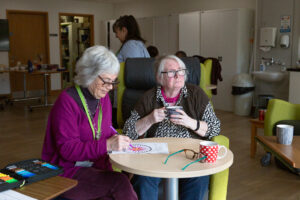
I am now in my ninth year, volunteering twice a week in the Living Well Service and have loved the teams that I belong to and the patients who come each week. I can witness first hand how much the patients benefit from the time they spend with the team and enjoy attending. I am aware that like them, I receive as much as I give. I have been able to use my experience in many ways, listening, Life Stories, creativity and leading the relaxation group at the end of each morning.
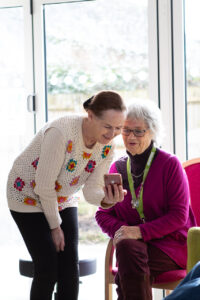
I was even lucky enough to be chosen to receive a High Sherriff award for outstanding service in 2022!
When the time is right for me, I shall relinquish my roles at Arthur Rank Hospice Charity. I know I will experience feelings of sadness after so many years of work with the Hospice movement. I have learnt so much about loss and change, death and dying and living well, which is enriching as I explore my own journey into ageing and all that unfolds as it does.”

Elizabeth recently made a wonderful tapestry and kindly donated it to the Hospice and it is displayed in our Sanctuary.
If you would like to volunteer for the Charity, please visit arhc.org.uk/volunteer
View other stories
-

Hospice Volunteer Gardeners win Gold at BBC Gardeners World Autumn Fair 2026
Garima, Adam and team were delighted to win Gold for all the volunteer gardeners and the Charity
-
Hospice Volunteer Gardeners enter ballot at BBC Gardeners World Autumn Fair
Gardeners, Garima Chandra and Adam Saunders explain more about their garden display
-
Volunteers thanked for supporting the Charity
Volunteer Tea Parties were held at the Hospice and at the Alan Hudson Centre
-
Hospice Volunteer cycles from London to Paris to support patients care
Debbie shares her motivation for signing up to the London to Paris challenge and shares her experiences